
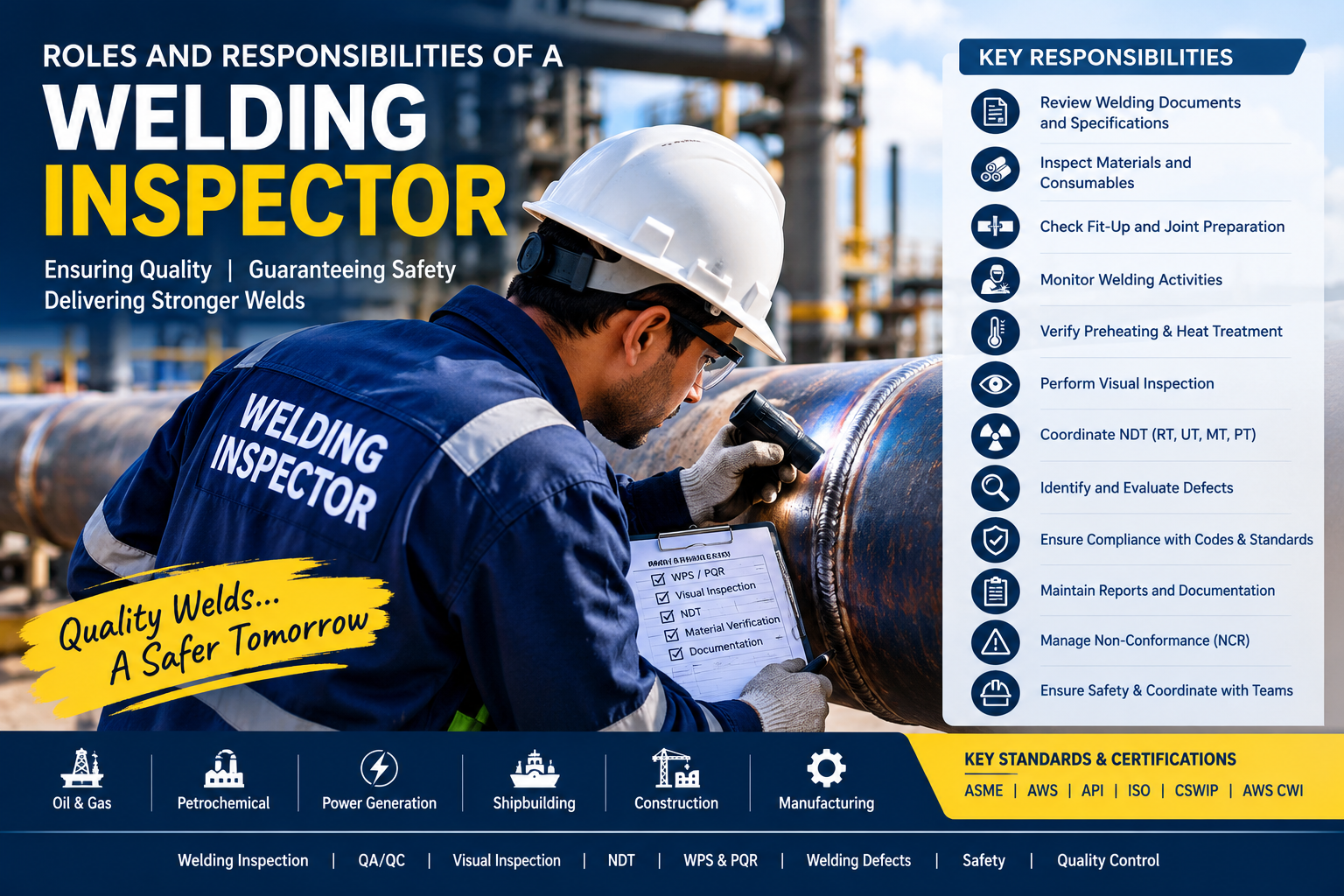

A Welding Inspector plays a vital role in ensuring the quality, safety, and reliability of welded joints in industries such as oil and gas, construction, petrochemicals, power plants, shipbuilding, and manufacturing. The primary responsibility of a welding inspector is to verify that all welding activities comply with approved welding procedures, project specifications, international welding codes, and quality standards.
A qualified welding inspector helps prevent welding defects, ensures structural integrity, maintains quality documentation, and confirms that welded components meet the required acceptance criteria before they are released for further fabrication, installation, or service.
1. Reviewing Welding Documents and Specifications
One of the main responsibilities of a welding inspector is to review and verify all welding-related documents before the commencement of welding activities. These documents include Welding Procedure Specifications (WPS), Procedure Qualification Records (PQR), welder qualification certificates, engineering drawings, material specifications, inspection and test plans (ITP), and project quality requirements.
The inspector ensures that the approved welding procedures comply with applicable codes and standards, such as ASME Section IX, AWS D1.1, API 1104, and relevant project specifications. Proper document review helps ensure that welding operations are carried out according to approved technical requirements.
2. Performing Material Inspection and Verification
A welding inspector is responsible for verifying the base materials, welding consumables, and filler materials before they are used in fabrication. This includes checking material certificates, heat numbers, material grades, dimensions, and traceability records to ensure compliance with project requirements.
The inspector also verifies that welding electrodes, filler wires, and other consumables are stored, handled, dried, and issued according to the manufacturer’s recommendations and approved welding procedures. Proper material verification helps prevent material mix-ups, contamination, and welding quality issues.
3. Conducting Fit-Up and Joint Preparation Inspection
Before welding begins, the welding inspector examines the prepared joints to confirm that they meet the approved drawings and welding procedure requirements. This inspection includes checking bevel angles, root gaps, root faces, alignment, joint cleanliness, and tack weld quality.
The inspector ensures that the surfaces are free from oil, grease, rust, moisture, paint, and other contaminants that could affect weld quality. Proper fit-up inspection reduces the risk of welding defects such as incomplete penetration, lack of fusion, excessive reinforcement, and misalignment.
4. Monitoring Welding Activities
During welding operations, the welding inspector monitors the work to ensure compliance with the approved Welding Procedure Specification (WPS). Important parameters include welding current, voltage, travel speed, welding process, electrode type, polarity, and the required preheat and interpass temperatures.
The inspector verifies that qualified welders are performing the work and following the specified welding techniques. Continuous monitoring helps identify deviations at an early stage, minimizes rework, and ensures that the welding process meets the required quality standards.
5. Inspecting Preheating and Post-Weld Heat Treatment
The welding inspector verifies that preheating and interpass temperature requirements are followed whenever specified by the approved welding procedure or applicable code. Temperature measurements may be performed using temperature-indicating crayons, contact thermometers, or calibrated temperature-measuring instruments.
Where post-weld heat treatment (PWHT) is required, the inspector reviews the heat treatment procedure, temperature charts, heating and cooling rates, soaking temperature, and holding time. Proper temperature control helps reduce residual stresses and the risk of cracking while supporting the required mechanical properties of the welded joint.
6. Performing Visual Welding Inspection
Visual Testing (VT) is one of the most important inspection activities performed by a welding inspector. It involves examining completed welds for visible surface defects and verifying that the weld profile and dimensions meet the applicable acceptance criteria.
The inspection may include checking weld size, reinforcement, undercut, overlap, surface cracks, porosity, arc strikes, spatter, and other visible discontinuities. The inspector also checks weld identification, location, and general workmanship to determine whether the weld is acceptable or requires repair.
7. Coordinating Non-Destructive Testing (NDT)
A welding inspector coordinates or reviews Non-Destructive Testing (NDT) activities to assess weld integrity without damaging the component. Depending on the project requirements, the inspection methods may include:
- Radiographic Testing (RT): Detects internal weld discontinuities using X-rays or gamma rays.
- Ultrasonic Testing (UT): Uses sound waves to detect and evaluate internal discontinuities.
- Magnetic Particle Testing (MT): Identifies surface and near-surface discontinuities in suitable ferromagnetic materials.
- Liquid Penetrant Testing (PT): Detects surface-breaking discontinuities in nonporous materials.
- Visual Testing (VT): Identifies visible surface imperfections and verifies weld appearance.
The welding inspector ensures that the required NDT is performed by qualified personnel, reviews the test reports, and verifies that the results comply with the specified acceptance criteria. Where required, specialized NDT personnel perform and interpret the examinations.
8. Identifying and Evaluating Welding Defects
A welding inspector must be capable of recognizing common welding defects and determining whether the observed discontinuities meet the applicable rejection criteria. Typical welding defects and discontinuities include cracks, porosity, slag inclusions, lack of fusion, incomplete penetration, undercut, excessive reinforcement, and burn-through.
When unacceptable conditions are identified, the inspector documents the findings and coordinates corrective action with the welding supervisor, quality control team, and relevant engineering personnel. Any weld repair must follow an approved repair procedure and be reinspected according to the project requirements.
9. Ensuring Compliance with Welding Codes and Standards
A key responsibility of a welding inspector is to ensure that welding activities comply with applicable codes, standards, specifications, and regulatory requirements. Depending on the project and industry, these may include ASME, AWS, API, ISO, and other relevant standards.
The inspector verifies that welding procedures, welder qualifications, inspection methods, testing requirements, and acceptance criteria are correctly applied. Maintaining compliance helps ensure the safety, durability, and serviceability of welded structures, pressure vessels, pipelines, and industrial equipment.
10. Maintaining Welding Inspection Reports and Documentation
Accurate documentation is essential for welding quality control and project traceability. A welding inspector prepares and maintains inspection reports, weld maps, material traceability records, welder identification details, WPS references, NDT reports, repair records, and inspection checklists.
The inspector also records inspection results, non-conformities, corrective actions, and final acceptance status. Proper documentation provides evidence that the welding work has been inspected and verified according to project quality requirements and supports future audits, maintenance, and compliance reviews.
11. Managing Non-Conformance Reports (NCRs)
When welding work fails to meet specified requirements, the welding inspector identifies and reports the non-conformance. This may involve incorrect welding parameters, unapproved materials, unacceptable weld defects, incomplete documentation, or deviations from approved procedures.
The inspector works with the quality assurance and quality control (QA/QC) team to document the issue, establish the required corrective action, and verify that the approved disposition has been implemented. The affected weld is reinspected or retested as required before acceptance.
12. Verifying Welder Qualifications and Performance
A welding inspector checks that welders are qualified for the welding process, material group, welding position, thickness range, and other applicable variables required for the assigned work.
The inspector verifies welder qualification records and confirms that the production welding activity falls within the scope of the applicable qualification. Monitoring welder performance also helps identify recurring defects and supports continuous improvement in welding quality.
13. Inspecting Completed Welds and Final Acceptance
After welding is completed, the welding inspector performs final visual inspection and verifies that all required examinations and tests have been completed. This includes reviewing dimensional measurements, NDT results, repair records, heat treatment records, and other inspection documentation where applicable.
The inspector compares the results against the relevant code acceptance criteria, approved drawings, and project specifications. Welds that meet the requirements are accepted in accordance with the project’s inspection and approval process, while unacceptable welds are referred for corrective action.
14. Ensuring Workplace Safety During Welding Inspection
A welding inspector must follow applicable health, safety, and environmental requirements while conducting inspections at fabrication shops, construction sites, pipelines, and industrial facilities.
Responsibilities include complying with permit-to-work systems, wearing appropriate personal protective equipment (PPE), recognizing hot-work hazards, following confined-space requirements, and maintaining safe distances during radiographic testing. The inspector should also report unsafe working conditions and coordinate with the safety team to help maintain a safe working environment.
15. Coordinating with Project and Quality Teams
A welding inspector works closely with welding supervisors, fabrication teams, QA/QC engineers, NDT technicians, construction managers, and client representatives to ensure that inspection activities are completed according to the project schedule and quality plan.
The inspector communicates inspection findings, reports welding deficiencies, coordinates hold-point and witness-point inspections, and follows up on outstanding quality issues. Effective communication and coordination help prevent delays, reduce rework, and maintain overall project quality.
Essential Skills Required for a Welding Inspector
A competent welding inspector should possess a combination of technical knowledge, inspection experience, and communication skills, including:
- Strong knowledge of welding processes such as SMAW, GTAW, GMAW, and FCAW.
- Understanding of welding codes, standards, and acceptance criteria.
- Knowledge of Welding Procedure Specifications (WPS) and Procedure Qualification Records (PQR).
- Practical experience in visual welding inspection and weld defect identification.
- Understanding of Non-Destructive Testing (NDT) methods and reports.
- Knowledge of material identification, traceability, and welding consumables.
- Ability to prepare inspection reports and maintain quality documentation.
- Familiarity with QA/QC procedures, Inspection and Test Plans (ITPs), and NCR management.
- Good communication, reporting, and problem-solving skills.
- Awareness of industrial safety requirements and permit-to-work systems.
Relevant certifications, such as AWS Certified Welding Inspector (CWI) or CSWIP Welding Inspector, may be required or preferred depending on the employer, project specifications, and applicable industry standards.
Conclusion
The welding inspector is a critical member of the quality control team, responsible for ensuring that welding activities meet approved procedures, project specifications, and applicable international standards. From material verification and fit-up inspection to welding surveillance, visual inspection, NDT coordination, defect evaluation, and final acceptance, the inspector helps maintain the quality and integrity of welded components.
A skilled welding inspector contributes to workplace safety, minimizes welding defects, reduces costly repairs, improves productivity, and ensures reliable fabrication in industries such as oil and gas, construction, petrochemicals, power generation, and manufacturing.
Roles and responsibilities of a welding inspector, welding inspector duties, welding inspection checklist, welding quality control, QA/QC welding inspector, welding inspection procedures, visual welding inspection, welding defects and acceptance criteria, WPS and PQR, NDT inspection, ASME welding codes, AWS welding standards, CSWIP Welding Inspector, AWS CWI, and oil and gas welding inspection.
